

Best Practices for HVAC Temperature Sensor Installation
A building automation system (BAS) network consists of many peripheral devices, with temperature sensors providing one of the most critical inputs. Temperature sensors are essential electronic components that help maintain occupant comfort, improve energy efficiency, and ensure optimal HVAC system performance.
Proper sensor installation is important to ensure accurate temperature readings and reliable system operation throughout the building.
Understanding the Role of Temperature Sensors in BAS
Temperature sensors measure the temperature of ambient air, chilled or hot water, refrigeration systems, or other surfaces and convert that measurement into an electrical signal.
The BAS controller interprets this real-time temperature signal and adjusts the system’s heating, cooling, or ventilation accordingly.
Common sensor types typically include thermistors and RTDs, each offering different levels of accuracy and response time. Both sensor types provide a resistance signal to the controller, which the controller converts into a temperature value.
The BAS system then determines how to operate building systems such as valves, dampers, fans, and air handling units.
By providing accurate temperature data, these sensors enable the system to maintain occupant comfort, optimize energy efficiency, and ensure HVAC equipment operates within its designed temperature ranges.
Temperature Sensor Types and Installation Best Practices
Selecting the right temperature sensor depends on factors such as accuracy requirements, mounting environment, temperature range, response time, and cost.
Control engineers typically determine the most suitable sensor type for the application, while the BAS controller establishes sensor type compatibility.
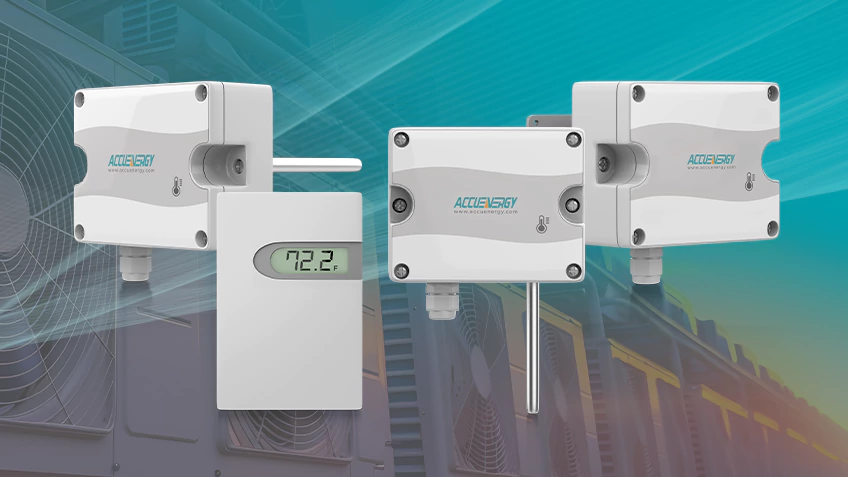
The AcuTEMS Series temperature sensors are available in multiple mounting configurations, including duct mount, room/wall mount, immersion, and outside air sensors. The following sections detail types of AcuTEMS sensors and their specific installation best practices.
AcuTEMS DM Duct Mount Temperature Sensors
The AcuTEMS DM duct mount temperature sensors measure the temperature of air flowing through HVAC ductwork.
These sensors are typically installed in supply, return, or mixed air streams to provide the BAS with accurate air temperature data, enabling it to regulate heating or cooling output and maintain proper airflow conditions.
Best installation practices include:
- Position the probe tip in the center of the airflow where the least amount of stratification is present, so select the probe length accordingly.
- Ensure the sensor is mounted away from any sources of air turbulence or obstructions, such as filters, heating/cooling coils, and dampers. Turbulent air can cause inaccurate, erratic temperature readings.
- Mount the sensor on the side or top of the ductwork to prevent condensation from entering the sensor and causing damage.

AcuTEMS RM Room Mount Temperature Sensors
The AcuTEMS RM room mount temperature sensors measure the temperature in occupied zones and provide the BAS controller with the data needed to maintain comfortable, healthy indoor conditions.
These sensors are typically installed on interior walls in offices, classrooms, or conference rooms and are available with or without an LCD for local temperature display.
For accurate readings, the sensors should be installed at typical occupant height, usually 4 to 6 feet above the floor.
Best installation practices include:
- Mount the sensor in an area where air circulation is well mixed and not blocked. Ensure there are no obstructions near the mounting location, such as curtains, furniture, doors, or other objects.
- Do not mount near heat sources such as hot water pipes, direct sunlight, space heaters, or electrical equipment that generates heat.
- Mount away from cold sources such as dehumidifiers and fans.
- Do not mount next to supply heating/cooling registers, air vents, windows, or poorly insulated walls. Infiltration of cold air can affect the temperature reading.

AcuTEMS IM Immersion Temperature Sensors
The AcuTEMS IM immersion sensors measure the temperature of liquids such as chilled water, hot water, storage tanks, and condenser water in HVAC piping systems.
The sensor requires a thermowell that allows the probe to be inserted into the pipe without direct exposure to the fluid, enabling the sensor to be removed or replaced without draining the system.
The AcuTEMS IM comes with a 304 stainless steel (304SS) thermowell with pre-applied heat transfer paste to ensure accurate temperature measurement.
Best installation practices include:
- Confirm that the chemical medium being monitored is compatible with the thermowell material. The most common are stainless steel and brass.
- Avoid placing the sensor in areas with high turbulence or excessive vibration.
- Install the sensor against the direction of flow at 45° or 90° to the pipe where the medium temperature is well mixed.
- Choose the appropriate thermowell insertion depth to position the tip at or near the centerline of the pipe. Ensure the entire thermowell is fully immersed in the monitored medium.
- If the sensor probe insertion depth is longer than the diameter of the pipe, the sensor should be installed in a pipe elbow or tee fitting against the flow.

AcuTEMS OA Outside Air Temperature Sensors
The AcuTEMS OA outside air temperature sensors measure ambient outdoor conditions and provide critical information for HVAC control strategies such as economizer operation, heating schedules, and energy optimization.
These sensors must be installed in locations that represent true outdoor air conditions, and the enclosure must be rated for protection against moisture and dust in outdoor environments.
Best installation practices include:
- Mount the sensor on the north side of the building, if possible, to minimize direct sunlight that can affect temperature readings. If the building is located in the Southern Hemisphere, mount the sensor on the south side of the building.
- Mount the sensor at least 3.5’ (1 m) above the ground to prevent thermal radiation from causing inaccurate temperature readings and to avoid water splash.
- Mount the sensor at least 2’ (0.6 m) below the cover or eave to prevent thermal radiation.
- Avoid locations near equipment that produces heating or cooling, such as building vents, fan exhausts, or dampers, as this equipment can affect the accuracy of temperature readings.

Learn More
By understanding the purpose of each sensor type and following proper installation practices, HVAC professionals can ensure accurate and reliable temperature measurements.
To learn more about Accuenergy AcuTEMS Series temperature sensors, visit www.accuenergy.com/bas-sensors or contact our product experts at www.accuenergy.com/contact.