

AcuCloud Carbon Module for Scope 1 and Scope 2 Emissions Tracking
Accurate carbon emissions measurement is increasingly crucial for commercial buildings to comply with regulatory mandates. Scope 1 and Scope 2 emissions refer to auditable data used to track, manage, and report greenhouse gas (GHG) emissions that are required by global standards and local codes. The AcuCloud Carbon Module provides an integrated solution for automatically calculating and tracking Scope 1 and Scope 2 emissions within the AcuCloud Energy Management Software.
Understanding Scope 1 and Scope 2 Emissions
While each scope is meant to track greenhouse emissions, each serves as different purposes for operational responsibility and emissions control.
Scope 1 emissions are direct GHG emissions from on-site combustion sources such as natural gas systems and fuel oil consumed in heating systems, boilers, or generators. Compliance with building standards often requires monitoring the emissions to improve energy efficiency.
Scope 2 emissions are indirect emissions from consumption of purchased electricity, steam, heating, or cooling. Though generated off-site, the organizations are accountable as it is the indirect result of energy consumption caused by the facility. Scope 2 emissions are calculated using both location-based and market-based methods.
Integration of Emission Scopes with AcuCloud Carbon Module
The AcuCloud Carbon Module automatically tracks and calculates Scope 1 and Scope 2 GHG emissions directly from metered energy data or utility bills, converting usage data into emission metrics. This integration eliminates the need for manual calculations, reducing the probability of error.
The Carbon Module supports location-based and market-based methodologies. This enables organizations to align emissions reporting with accepted greenhouse gas accounting standards while supporting utility procurement and sustainability reporting strategies.
Aligning with current EPA eGrid and IPCC methodologies, the AcuCloud Carbon Module supports tracking of electricity, natural gas, thermal, and BTU (British Thermal Unit) energy data. Organizations can configure custom emission factor to standardize calculations and meet sustainability targets.
Compliance with Building Code Standards
Building codes and performance standards require rigorous carbon tracking for regulatory compliance and ESG reporting. The AcuCloud Carbon Module provides on-demand emissions reports on demand for Environmental, Social, and Governance (ESG) disclosures, Global Real Estate Sustainability Benchmark (GRESB) reporting, sustainability reporting, and internal carbon reduction programs.The AcuCloud Carbon Module supports reporting workflows for evolving building performance standards and emissions regulations, including NYC Local Law 97 and Vancouver Clean Building Policy.
New York City Local Law 97 (LL97) sets GHG limits for buildings over 25,000 square feet. The regulation requires buildings to monitor emissions, verified reporting, meet prescribed carbon intensity limits based on occupancy, and reduce emissions with time.
Similarly, under the zero-emissions building plan, the city of Vancouver aims to achieve zero emissions in new constructions. The plan is to reduce embodied carbon emissions to around 40% by 2030. Buildings must track emissions and demonstrate measurable reduction in carbon intensity.
The AcuCloud Carbon Module automates the emissions calculation and report generation, reducing administrative workload and maintaining consistent, traceable emissions records.
Deploying AcuCloud Carbon Module in the Existing AcuCloud Infrastructure
Facilities which are operating on the AcuCloud platform can integrate the Carbon Module directly to any existing meter data and utility billing information. AcuCloud, when paired with Acuvim II or AcuRev 4100 Series meters for multipoint power monitoring and tenant billing. The AcuCloud platform supports third party electrical meters using the AcuLink 810 as a gateway device.
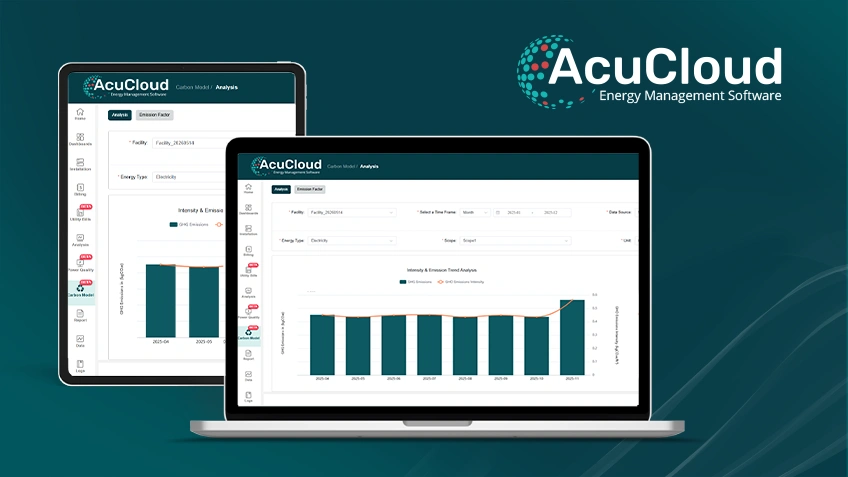
The Carbon Module interface provides a structured and granular approach to filter and analyze the footprint data. The feature has two functional areas, Analysis and Emission Factor. Within the Analysis view, the interface pivots between intensity and emission analytics and facility level emission. The interface provides multiple filters to view the tracked data based on facility selection, time frame, data source, energy type, scope type, and unit of measurement.
The AcuCloud Carbon Module is designed to offer a reliable, automated approach to tracking, managing, and reporting emissions. For organizations to meet the mandatory requirements for Scope 1 and 2 emissions, the integration of the AcuCloud Carbon Module in the AcuCloud platform establishes a simple solution for sustainability management.
To learn more about AcuCloud Energy Management Software, visit
www.accuenergy.com/acucloud.